


The client had a highly focused outbound sales strategy supported by a relatively small team. One salesperson, a sales support specialist, and a manager were responsible for developing relationships across more than 1,000 target accounts.
While the client had accumulated a valuable list of prospective companies, determining where to focus each day had become increasingly difficult. Representatives spent significant time filtering records, comparing account activity, reviewing company details, and deciding which organizations deserved immediate attention. The information existed inside HubSpot, but there was no consistent framework for turning that data into actionable priorities.
As a result, the team was spending more than 10 hours each week organizing prospect lists instead of engaging with customers. Opportunities to reconnect with active accounts could easily be overlooked, while sales efforts often depended on individual judgment rather than a repeatable process.
The client needed a system that would automatically identify their highest-value opportunities, adapt as prospect engagement changed, and provide the sales team with a clear picture of who should be contacted next.
Our Approach
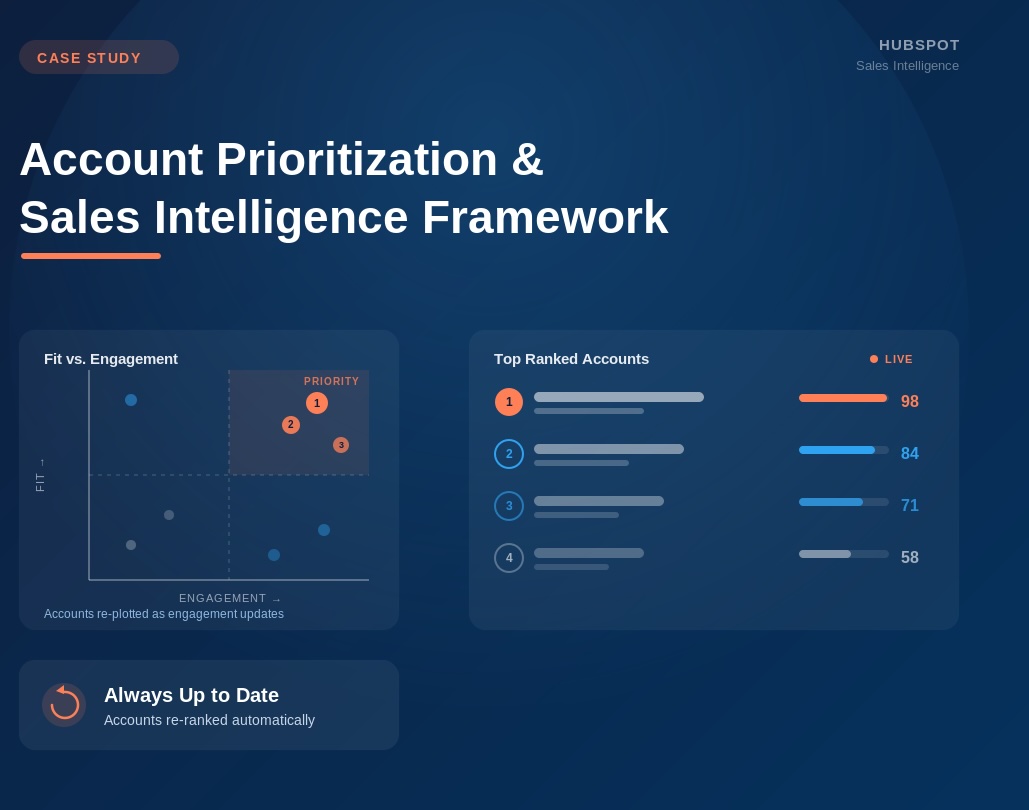
We worked with the client to develop an account prioritization framework that combined business fit with real-time buying signals, allowing HubSpot to continuously rank target accounts based on both long-term potential and current engagement.
The first component focused on company fit. Firmographic and demographic data, including characteristics the client identified as indicators of an ideal customer, were fed into HubSpot’s Lead Scoring tools to generate a Fit Score for every target account.
The second component measured engagement. Recent website activity, marketing interactions, and other behavioral signals contributed to a separate Engagement Score that reflected how actively each company was interacting with the business.
Rather than relying on either score independently, we created a tiering system that combined both factors into a practical prioritization model. Accounts were grouped into tiers based on strategic value, with engagement continually influencing how those companies were ranked within each group. This meant that the highest-value prospects naturally rose to the top as buying interest increased, while less active companies moved lower until engagement returned.
To support ongoing sales planning, we also created custom properties that tracked when scores changed, measured engagement trends over time, highlighted inactivity, and compared historical performance between accounts that had recently engaged with the sales team and those that had not been contacted for more than a year.
Finally, we developed dashboards and filtered views that gave the sales team immediate visibility into weekly engagement changes, account movement between tiers, and the highest-priority companies requiring outreach.
Results
The new scoring framework transformed the client's approach to outbound sales.
Instead of manually reviewing more than 1,000 accounts, the sales team began each day with a prioritized list generated automatically by HubSpot. Companies were ranked according to both strategic fit and current buying activity, allowing representatives to focus their efforts where they were most likely to produce results.
Interactive dashboards provided visibility into engagement trends across the account base while filtered views highlighted companies that had become more active, reducing the likelihood that valuable opportunities would be missed.
The client also introduced a three-tier account strategy, with approximately five percent of target accounts occupying the highest-priority tier at any given time. Because tiers adjusted dynamically as engagement changed, the team’s priority list evolved throughout the year instead of becoming stale or requiring manual maintenance.
Most importantly, the project shifted the team’s focus away from administrative work and toward meaningful conversations with prospective customers. Rather than spending hours organizing data, the sales team gained a repeatable system that helped them identify the right accounts, at the right time, using information that updated automatically as prospect behavior changed.