


The Problem
Many organizations invest in HubSpot expecting it to streamline their sales process, only to discover that the platform still depends on constant manual maintenance. That was the challenge facing this client.
Their sales cycle involved numerous stages, multiple stakeholders, and several handoffs between sales, application engineering, and other internal teams. Every opportunity contained multiple associated contacts, but those relationships were inconsistent, making it difficult for everyone involved to see the same information or understand the current status of a deal.
As opportunities progressed, sales representatives and managers were responsible for manually updating deal stages, changing lifecycle statuses, sending follow-up communications, and ensuring records stayed synchronized. Third-party participants in the process also lacked an easy way to contribute updates without introducing inconsistencies into the CRM.
The administrative burden became substantial. Sales leadership was spending more than 15 hours every week cleaning data, correcting records, and advancing deals through the pipeline instead of coaching the team or focusing on revenue-generating activities. The client needed a system that could handle routine process management automatically while maintaining accurate data throughout the customer journey.
Our Approach
Rather than asking users to become more disciplined about updating HubSpot, we redesigned the process so the system performed much of the work automatically.
Using HubSpot Sales Hub Professional and Marketing Hub Professional, we developed a series of workflows that connected every stage of the client’s sales process. Related contacts were automatically associated with deals, ensuring every stakeholder had access to consistent information without requiring manual maintenance.
We also built workflow automation that advanced deals through the pipeline based on real customer activity instead of relying solely on manual updates. Meeting scheduling, record changes, and other key actions triggered the appropriate follow-up tasks, emails, and property updates, allowing the sales process to continue moving even when multiple teams were involved.
To provide consistency across marketing and sales, we synchronized lifecycle stages from initial inquiry through qualified lead, active opportunity, and Closed Won. This ensured reporting remained accurate while eliminating many of the manual updates previously required.
Finally, we developed custom dashboards and saved views that gave leadership immediate visibility into pipeline activity, highlighted exceptions requiring attention, and made it much easier to verify that automation was working as expected.
Results
The new system dramatically reduced the amount of manual administration required to keep HubSpot accurate and up to date.
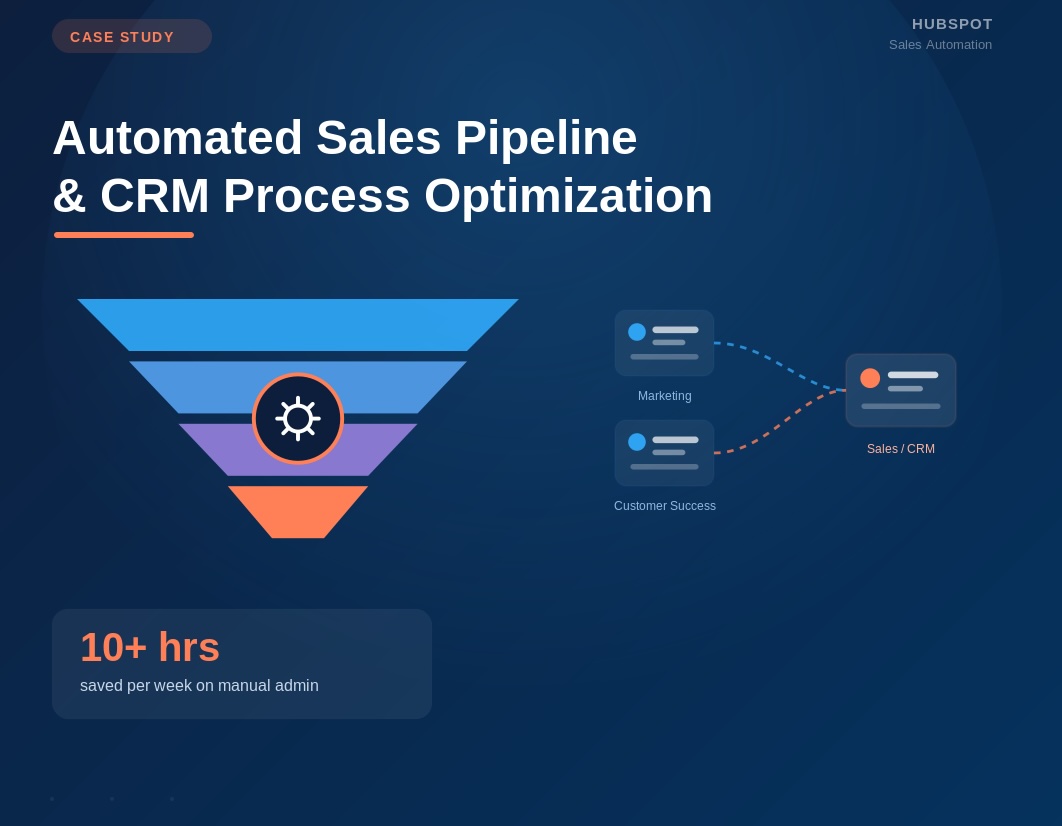
More than 10 hours of repetitive CRM maintenance were eliminated each week, freeing sales leadership to spend more time coaching representatives, supporting strategic opportunities, and growing the business instead of correcting records.
Because associations, lifecycle stages, and deal progression were managed automatically, the client also experienced greater consistency across their sales process. Teams could trust that the CRM reflected the current state of each opportunity without requiring constant manual intervention.
Perhaps most importantly, the automation reduced friction between sales, application engineering, and other stakeholders by ensuring everyone worked from the same data and the same process. Instead of treating HubSpot as another administrative task, the client gained a CRM that actively supported the sales team, improved visibility, and scaled with the business.